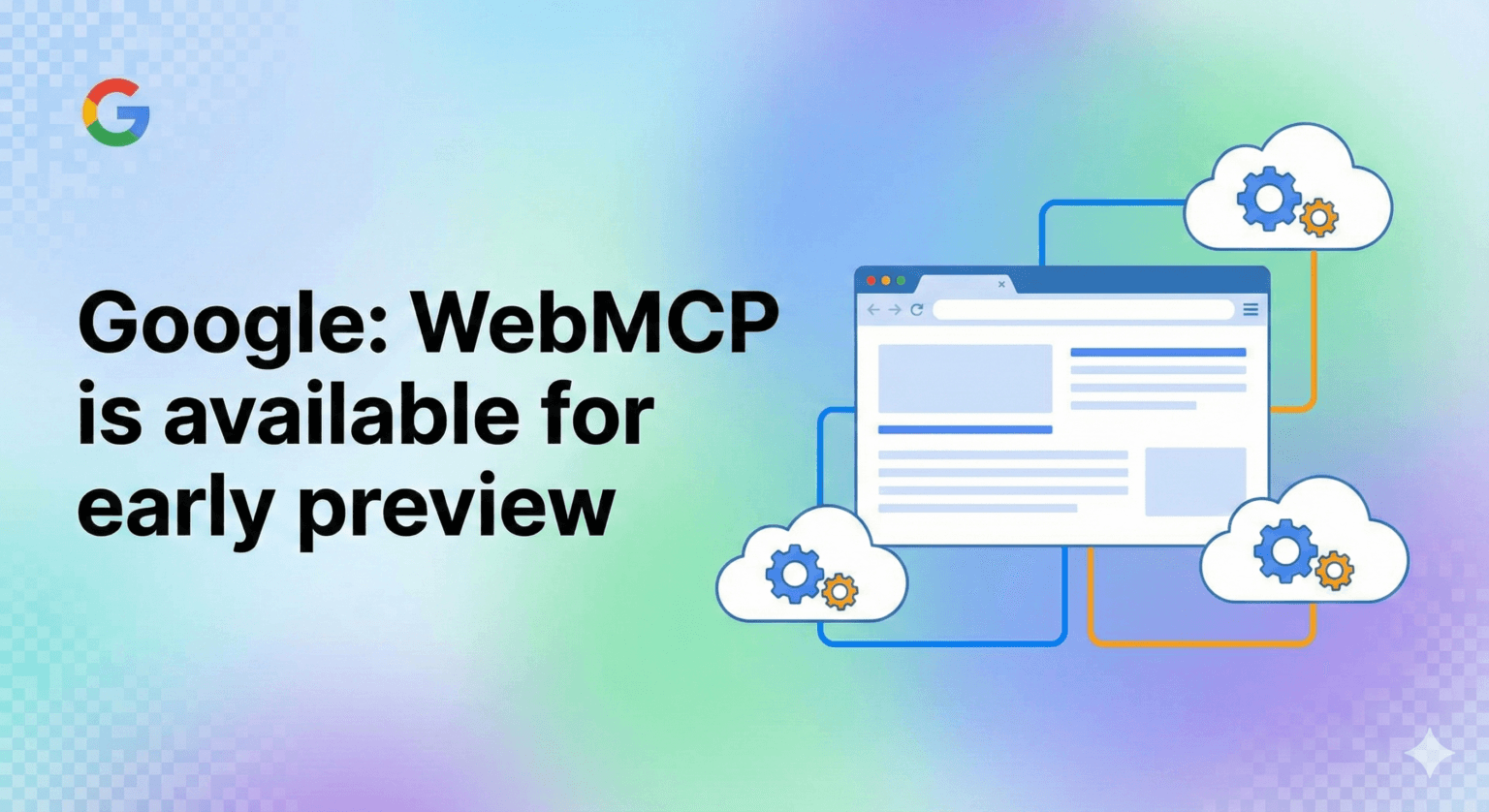
Google Officially Launched WebMCP: What This Means for the Future of AI Browsing
A major new Google launch changes how AI interacts with the web. Find out what WebMCP is and how it will impact SEO and browsing.
Florin Cristian
SEO & AIO Specialist
Summary
Google has launched an early preview for WebMCP (Web Model Context Protocol), a new native browser protocol that standardizes how AI agents interact with websites. It allows sites to communicate their capabilities directly to agents through "Tool Contracts," replacing screen scraping techniques with precise, tool-based interactions. This approach improves token efficiency and task accuracy for AI agents, signaling a major shift for web development and SEO.
Google Launches WebMCP in Early Preview: The New Standard for AI Agent Interactions on the Web
Google has officially released a preliminary version of WebMCP (Web Model Context Protocol), a new native browser protocol that redefines how AI agents interact with websites. Announced by André Cipriani Bandarra (Google developer) on the Chrome Developers blog, WebMCP introduces a structured and standardized way for sites to communicate their functionalities directly to AI agents — replacing unreliable DOM parsing and screen scraping methods with precise interactions directly at the source.
What is WebMCP and Why Does It Matter?
WebMCP allows websites to publish a machine-readable "Tool Contract" — essentially a clear list of actions AI agents can perform on a specific site. Through a new browser API called navigator.modelContext, a website can expose specific functions, such as booking a flight, submitting a support ticket, or searching a product catalog. Instead of an AI agent guessing which buttons to click or which forms to fill out, it receives structured instructions and can execute actions directly.
The protocol introduces two complementary APIs:
- Declarative API: Works with standard HTML forms, making it easy to add "agent-ready" attributes to existing markup with minimal effort.
- Imperative API: Handles more complex, JavaScript-based interactions, where developers can register detailed tool schemas using
registerTool()— similar to how tool definitions work with API endpoints from OpenAI or Anthropic, but running entirely client-side in the browser.
This approach offers significant advantages over current vision-based methods. According to early performance tests, WebMCP provides up to an 89% improvement in token efficiency compared to screenshot-based interactions, while increasing task accuracy to approximately 98%.
How You Can Access the WebMCP Early Preview
WebMCP is currently available in Chrome 146 Canary, hidden behind the "WebMCP for testing" feature flag. Developers need to sign up for Google's Early Preview Program (EPP) to gain access to full documentation, demos, and API specifications. The EPP allows engineers to test how different Large Language Models (LLMs) interpret their tool descriptions and refine them before the protocol becomes a global standard.
The specification is being developed in collaboration with Microsoft and is being incubated through the W3C Web Machine Learning community group, signaling a serious effort to turn WebMCP into an official web standard. Industry observers expect formal announcements regarding native browser support by mid-to-late 2026, with Google Cloud Next and Google I/O being ideal moments for a broader rollout.
What WebMCP Means for SEO and the "Agentic Web"
For SEO professionals and web developers, WebMCP represents what some experts are already calling the biggest shift in technical SEO since the introduction of structured data (schema markup). As AI agents become capable of directly calling website functions, how content is discovered, displayed, and monetized will fundamental change.
Sites that implement WebMCP early will have a huge competitive advantage in an internet increasingly dominated by AI agents. E-commerce sites can guide AI agents through product searches and checkout processes in a much more reliable way. Travel service providers can facilitate fully automated flight searches and bookings. Customer support systems can accept much more detailed, auto-filled tickets — all of which reduce friction points in the User Experience and improve conversion rates.
It is important to note that WebMCP is architecturally different from the Model Context Protocol (MCP) developed by Anthropic. While Anthropic's MCP uses JSON-RPC for server-side integration at the backend level, WebMCP operates entirely client-side through native browser APIs. The two protocols are complementary: MCP connects AI agents to backend services, while WebMCP connects them to browser-based interfaces. Many organizations will likely need to support both protocols to ensure full coverage for agents.
Key Insights for Web Developers and Site Owners
WebMCP is still in its early stages, but the direction is clear: the web is being reconfigured specifically for AI agents. Developers and SEO professionals should start familiarizing themselves with the protocol now, join the Early Preview Program, and evaluate how existing HTML forms and site architecture can be adapted for "agent-ready" interactions. Those who adapt quickly will be best positioned as the agentic web becomes the new industry standard.
Share this article
If you found this information useful, don't hesitate to share it with your colleagues or friends!